Built for shift work, not adapted to it

Most workforce systems handle a nine to five and struggle with anything else. Ours started in factories, so rotating shifts, night premiums, bank holiday rates and a workforce that clocks in at a terminal rather than a laptop are the normal case rather than an edge case.

Clockings come from biometric terminals on the floor or the mobile app for anyone off site, and land in the same records either way.

What that means in practice:

  • Who is on shift right now, across every site
  • Overtime and premiums applied to your rules, not a generic assumption
  • Hours by department or cost centre for labour reporting
  • No timesheets to collect and nothing re-keyed into payroll

Manual time tracking vs a clocking system

Comparing manual time tracking with a digital clocking system in manufacturing
What you are doing On paper With a clocking system
Recording the hours Written down and typed up, twice handled Captured at the terminal as it happens
Knowing who is on site Walk the floor and count On screen, and on the fire roll call
Someone clocking a mate in Easily done with a card or a sheet Far harder with biometric verification
Working out overtime By hand, per person, every period Calculated against your rules and split by rate
Getting it to payroll Re-keyed from one screen to another Exported ready to import, or straight into Sage on Realtime
Proving what happened Whichever sheet survived An audit trail of every clocking and amendment

The right system for your factory

Two products, and the honest answer is that most manufacturers suit one clearly more than the other. We will tell you which after a conversation about your shifts and your sites.

Syncro Connect

Cloud based, running in days, with a mobile app for drivers and anyone off site. Suits manufacturers who want shift tracking, attendance and absence without an installation, and who do not need job costing.

£2 per employee per month excl. VAT, or £3 with the app.

Explore Syncro Connect

Realtime

Installed on your own server or hosted by us, and the deeper of the two. Adds job costing, HR, document management, banked hours and direct Sage Payroll integration.

Quoted per installation. Access control works with either product.

Explore Realtime

UK manufacturing runs on its workforce

In a sector where labour is one of the largest controllable costs, knowing the hours precisely is not administration. It is margin.

2.6m

people employed in UK manufacturing

Make UK, 2025

9%

of total UK employment

Make UK, 2025

The workforce problems manufacturers actually have

Not the ones a brochure lists. These are the four that come up in every conversation.

Shift patterns nobody can calculate quickly

Rotating shifts, nights, weekend premiums and overtime thresholds. Doing that by hand for two hundred people is where the disputes over hours start.

Hours that are not quite right

A few minutes here, a clocking somebody else made there. On a large shift-based workforce it adds up quietly, and nobody notices until the labour cost does not match the output.

Records you would rather not be asked for

Rest breaks and weekly limits under the working time regulations, and a customer audit that wants to see them. Paper makes that a week’s work.

Finding out about absence too late

Two people short on a line and the supervisor learns at half past eight, by which point cover means overtime rather than a reshuffle.

Clocking that survives a factory floor

Our clocking in software replaces punch clocks and paper with biometric terminals, cards and fobs, or the mobile app for anyone off site. Most manufacturers end up with a mix.

Which credential suits you depends on hands and faces. Fingerprint struggles where hands are dusty, oily or worn, which describes most production floors by mid-morning, so facial recognition or palm is usually the better starting point in food production and engineering.

  • A whole shift through the door in minutes
  • Far harder for one person to clock in for another
  • Terminals that keep working when the network drops
  • Hours reaching payroll already worked out
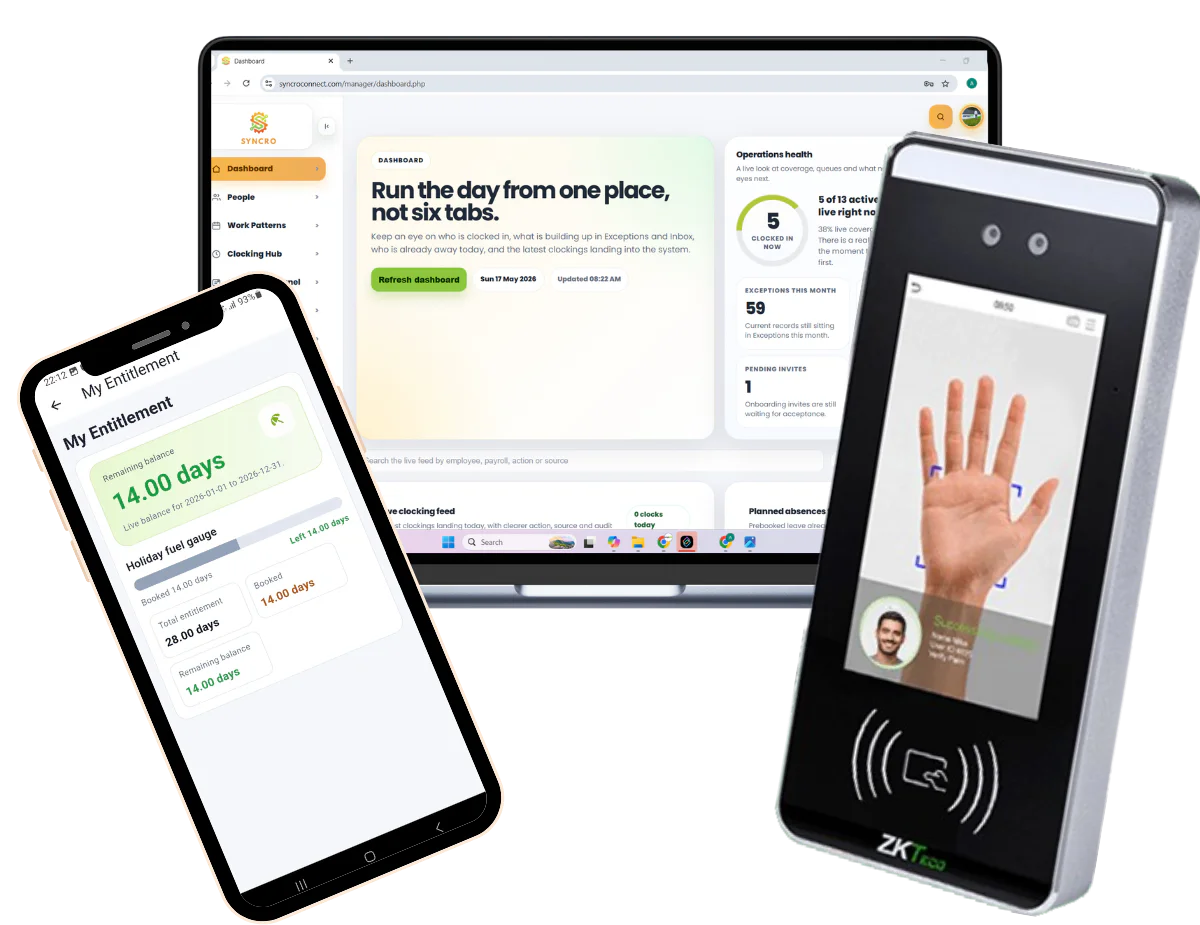
Computime workforce management shown on a desktop dashboard, mobile app and biometric clocking terminal

Fewer corrections after payday

Five minutes a shift, across two hundred people, is a considerable number by the end of the month, and it moves in whichever direction the recording error happens to go. Manual timesheets produce both overpayments and unpaid hours, and neither gets noticed until somebody complains.

Clockings recorded at the terminal remove the estimating. Overtime and premiums are applied to your rules before the figures leave the system, and the hours go into payroll without being re-keyed, which is where most of the remaining errors come from.

  • People paid for the hours they actually worked, in both directions
  • Problems flagged before the pay run rather than after it
  • Labour hours by line, shift or department when you need to cost something

The records, when somebody asks for them

Manufacturing gets audited more than most sectors, by regulators and by customers. What the system gives you is a time-stamped record of who was on site and what hours they worked, which is what those conversations need. Meeting the working time regulations is your job; having the evidence to hand is ours.

Headcount reports in seconds

Rather than somebody going through timesheets the week before an audit and hoping they all add up.

Who is on site right now

Across every shift and every entrance, including contractors signed in through visitor management.

An audit trail behind every figure

Every clocking, every amendment, and who made it. A record that can be quietly changed is worth nothing in a dispute.

A roll call that matches reality

The fire roll call is built from the same clockings, so it is right at the moment the alarm sounds rather than as it was that morning.

Knowing where you are, before it costs you

Most staffing decisions on a production floor are made on incomplete information. Somebody has not turned up, nobody is sure who, and by the time it is established the options have narrowed to overtime.

Live attendance does not schedule anything for you. What it does is tell you the position at the moment you need to decide, which is usually the difference between a reshuffle and a premium rate.

  • See who is short at eight, not at ten
  • Overtime that was authorised rather than discovered
  • Absence patterns visible before they become a habit
  • Hours by line or department when you need to cost a run

A rota module is coming later in 2026. Until then, if scheduling is your main problem rather than recording, we will tell you that Realtime is the better fit and why.

Why choose Computime?

For over 35 years, since 1989, we have been putting clocking systems into UK factories. Long enough to know that the ones that fail do so because they were awkward to use at seven in the morning, not because of anything on a specification sheet.

We make the terminals as well as the software, so the reader on your wall and the hours reaching payroll come from one company. Direct Sage Payroll integration comes with Realtime, and both systems export for Sage, Pegasus and QuickBooks.

Built and supported by our own team in Leeds, with no minimum headcount and room to scale to 5,000 employees. When you call, you speak to someone here.

800+

UK businesses trust Computime systems

35+

years of UK workforce experience since 1989

4.5

average from 41 Google reviews

UK

based support team on hand when you need them

What our customers say

We are really pleased with our Computime solution. Introducing this system means that payroll is now processed accurately and efficiently, helping to boost morale both for our head office staff and our field teams. Real time data means we know where our employees are, allowing us to operate more efficiently.

James Dunlop

Financial Manager, Landworth Electrics

We are very pleased with the smooth implementation. Computime worked very hard to make sure installation was completed within the time frame and with minimum disruption. The in-depth training allowed us to focus on production and keeping our employees safe at work while ensuring efficiency.

Clare Barker

HR Manager, Wholebake Limited

I was tasked with sourcing a computerised time and attendance solution to replace our manual clocking system. The Computime website contained all the information I needed, making the decision straightforward. The software proved easy to use and the helpdesk was very helpful and friendly. Computime have exceeded all of our expectations and objectives. I would definitely recommend them.

Purchasing Manager

BSK Laminating

Manufacturing time and attendance FAQs

What manufacturers ask before changing a clocking system. If yours is not here, call the Leeds team on 0113 350 9043.

What time and attendance software suits factory workers?
The requirements that matter in a factory are different from an office. It has to handle rotating shifts, night and weekend premiums and overtime rules without somebody calculating them by hand. It needs a terminal robust enough for the floor, because most production staff do not carry a phone at work. It has to cope with a whole shift arriving inside ten minutes. And the hours have to reach payroll without being re-keyed. Any system that manages those four will serve a factory; plenty of well-known workforce platforms manage two or three.
Can it handle rotating and night shifts?
Yes, including shifts that cross midnight, which is where simpler systems come apart. You set the patterns, the premium rates for nights and weekends, when overtime starts and how bank holidays are treated, and those rules are applied to the recorded hours rather than to an assumption about a standard week. Getting the rules right at setup is where the value is, and we do that with you rather than handing over a manual.
Which clocking method works best on a production floor?
Usually not fingerprint, which surprises people. Flour, oil, dust and hands worn smooth by handling materials all cause failed reads, and by mid-morning that describes most of a production workforce. Facial recognition or palm handle those conditions, and palm also works where masks or visors are worn. Cards remain the simplest option and the one you need anyway for visitors and contractors.
How fast is it when a whole shift arrives at once?
A clocking takes about a second, so the question is really how many terminals you need and where they go. Two hundred people through one reader at ten past six will queue, whatever the technology. Tell us how your shift changes actually work and we will say how many readers and which entrances, rather than selling you one and letting you find out.
Does it work across multiple sites?
Yes, with one system across every plant and access restricted by site, so a manager sees their own people rather than scrolling past four hundred names to find twelve. Hours can be reported by site, department or cost centre, and somebody who works across two sites carries one credential rather than one for each.
Can we cost labour against production jobs?
Yes, with Realtime, where staff clock onto a job or batch rather than just onto shift, so you can see the hours a production run actually took against what you planned. Worth knowing that it costs labour time only, not materials or plant. If costing production jobs is the reason you are looking, Realtime is the product; Syncro Connect does not have job costing.
Does it replace our ERP or MES?
No, and it should not try to. We do time, attendance, absence and access. Production planning, machine monitoring, output tracking and skills matrices belong in an ERP or MES, and those systems do them far better than a workforce supplier would. What we do is make sure the labour hours going into whatever else you run are accurate, which is usually the part those systems depend on and handle worst.
What happens if the network or the internet goes down?
Terminals hold their own records and keep accepting clockings, syncing when the connection returns. Nobody stands at the door with a clipboard. On a site where a network outage would otherwise stop a shift being recorded, this matters more than most of the feature list.
Will the shop floor accept it?
More readily than most managers expect, provided two things are true. It has to be quick, because a system that adds thirty seconds to everyone’s morning gets resented and then worked around. And people need to be told what is recorded and why, particularly with biometrics, where an unexplained terminal appearing on the wall causes more trouble than the technology ever does. Accurate recording also works in the workforce’s favour, since overtime and early starts stop being forgotten.
How long does it take to put in?
Syncro Connect runs in days. Realtime takes longer because it is installed and there is more to configure. Either way the work is in your rules rather than the software: shift patterns, premium rates, overtime thresholds, how lateness is treated. That is a conversation with whoever runs your payroll, and it is worth doing carefully, because rules set wrongly at the start produce plausible-looking figures that are quietly wrong for months.
Start A Conversation

Left Menu Icon