Biometric attendance FAQs
The questions employers and their staff ask before putting biometrics in. If yours is not here, call the Leeds team on 0113 350 9043.
What is a biometric attendance system?▼
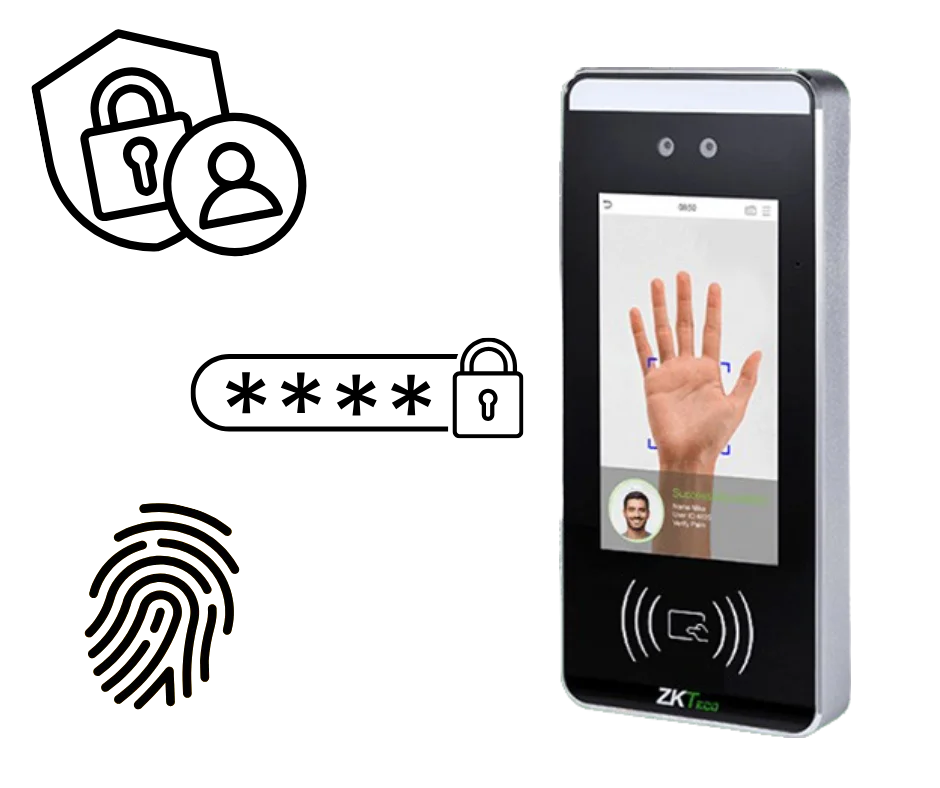
A biometric attendance system records when staff start and finish by identifying them from a physical characteristic, usually a fingerprint, face or palm, rather than a card or PIN. At enrolment the terminal converts the scan into a mathematical template; at each clocking it matches the live scan against that template. Because the credential is the person rather than something they carry, the hours recorded belong to whoever actually worked them.
Is biometric clocking legal in the UK?▼
Yes, and thousands of UK businesses use it, but there is more to put in place than with cards. Biometric data used to identify someone is special category data under UK GDPR, so you need an appropriate lawful basis and a condition for processing special category data, staff must be told clearly what is held and why, and a data protection impact assessment will normally be expected before you start. The
ICO’s biometric guidance sets it out, and it is shorter and plainer than people expect.
Can an employee refuse to give their fingerprint?▼
Yes, and you should plan for it rather than treat it as awkwardness. The ICO’s position is that if you rely on consent, it has to be freely given, which means an alternative that does not disadvantage the person who takes it. Our terminals also read cards, fobs and PINs, so someone who declines biometrics can still clock in the same queue at the same terminal. In practice a handful of people in any workforce will say no, and a system that cannot accommodate them creates a problem you did not need.
Do you store an image of my fingerprint?▼
No. What is stored is a template: a set of measurements taken from the distinctive points of the scan, held as data rather than as a picture, and not designed to be turned back into one. That makes it safer to hold than an image would be, but it is still biometric data and still special category data, so it is treated accordingly rather than treated as ordinary. Our
data security page sets out where it sits and who can reach it.
What happens to the data when someone leaves?▼
Deleting the employee removes their record and template from the database, but the terminals keep their own copy so they can work when the network is down, so the leaver has to be removed at the terminal as well. It is two steps rather than one, and it is the step most businesses miss. Worth building into your leaver process on day one, because a former employee’s fingerprint template sitting on a terminal two years later is exactly the sort of thing that is difficult to explain.
Does biometric clocking stop buddy punching?▼
It makes it far harder, which is the honest answer. A card can be handed over in the car park and a PIN can be shared over the phone; a fingerprint cannot be passed to a colleague in any practical way. That removes the common route rather than making it theoretically impossible, and for most businesses the value is not catching anyone but ending the argument about who started when.
What if a fingerprint will not read?▼
It happens, and anyone who tells you otherwise has not run one. Wet, dusty, cut or heavily worn hands all cause failed reads, and some people simply have prints that scan poorly. You can enrol more than one finger, and the terminal still accepts a card or PIN as a fallback. If a good proportion of your workforce has hands like that, which is common in food production, engineering and construction, facial or palm recognition is the better starting point.
Will staff object to biometric clocking?▼
Some will, and the objection is usually about the unknown rather than the technology. What we see work is telling people in advance what is recorded, that it is a template rather than a photograph, who can see it, what happens when they leave, and that there is an alternative if they would rather not. Rollouts that go wrong are almost always the ones where the terminal appeared on the wall without warning.
How much does a biometric attendance system cost?▼
Terminals start at £395 excl. VAT as a one-off, and the software is £2 per employee per month excl. VAT for
Syncro Connect. How many terminals you need depends on how many entrances you have and how many people arrive at once, which is worth a conversation rather than a guess. See our
terminal range.
Can biometric terminals also control doors?▼
Yes. The same terminal can clock someone in and release the door, so
access control and attendance become one event rather than two systems recording the same arrival. It also means one enrolment rather than enrolling everyone twice.
How long does enrolment take?▼
A minute or so per person. Fingerprints can be enrolled centrally with a USB enroller, so HR can do a department at a time rather than queueing everyone at a terminal; facial enrolment happens at the device. For a workforce of a hundred, plan an hour or two and do it alongside whatever briefing you are giving people about the change.