Time and attendance FAQs
What UK businesses ask us most. If yours is not here, call the Leeds team on 0113 350 9043.
Which industries does Computime work best for?▼
Manufacturing and food production, warehousing and logistics, healthcare and NHS services, retail, hospitality, education and construction. What those have in common is shift work, people who are not sat at a desk, and hours that have to be right before they reach payroll. We have sector pages for
manufacturing,
logistics,
healthcare,
retail,
hospitality,
education and
construction if you want the detail.
Can it record lateness, absence, illness, accidents and training time separately?▼
Yes. Absence and attendance types are set up to match your own categories, so sickness, unauthorised absence, jury service, training, medical appointments and accident-related time are each recorded as what they are rather than lumped together. That matters for reporting, and it matters for fairness, because some absence should not count towards absence triggers at all.
Does it work across multiple sites?▼
Yes. One system covers every site, with terminals at each and a single view across all of them. Permissions are set per person, so a site manager sees their own people and head office sees everything. Pricing is per employee, not per site or per device, so a second location does not cost extra.
What does time and attendance software cost?▼
Syncro Connect is £2 per employee per month, or £3 with the Syncro Connect app, excl. VAT. HR records and document management are a £1 per employee per month module on top. Annual billing is standard with monthly available, there are no setup fees, and 30 days’ notice to cancel.
Realtime is installed software and works differently, with a three month minimum renewal term and 90 days’ notice. Clocking terminals are a one-off from £395 excl. VAT if you want them, and direct Sage Payroll integration on Realtime is £395 a year. Across the UK market you will see roughly £1 to £8 per employee per month, and the spread usually comes down to what is bundled. Our
pricing page has a calculator.
Does it work with Sage, Xero and QuickBooks?▼
Realtime integrates directly with Sage Payroll, as a £395 a year module. Both products export approved hours for Sage, Pegasus, QuickBooks, Xero, BrightPay, IRIS and ADP, so nothing is re-keyed. We do not file anything with HMRC ourselves; your payroll software does that from the hours we give it.
Can managers run their own reports?▼
Yes, and most customers build the reports they want themselves rather than asking us. We will build one if you ask, but the point is that a manager wanting hours by department for last month should not have to raise a ticket and wait.
Do we need clocking hardware?▼
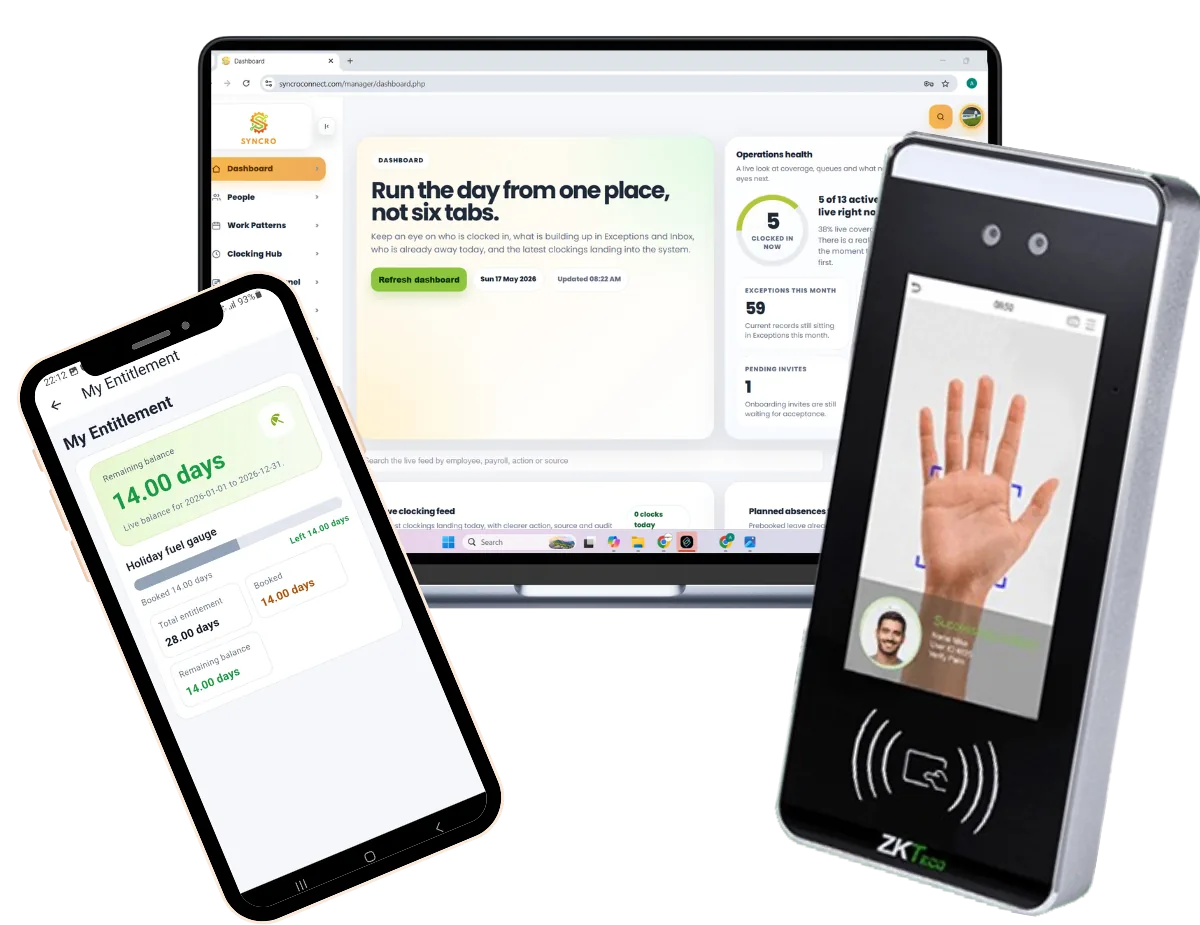
No. Staff can clock in from a web browser or their own phone with the
mobile app, with no fixed hardware at all. Terminals make sense where staff do not have work phones, or where you want a fixed point everyone passes. We supply
facial recognition,
fingerprint and card options from £395 excl. VAT, and plenty of sites mix the two.
Will our staff object to clocking in?▼
Some will, and it is worth taking seriously rather than assuming people will get over it. In our experience resistance comes from how it is introduced rather than from the clocking itself. If the first your team hears about it is a terminal appearing by the door, it reads as surveillance. If they hear why, usually that you want their pay right and their overtime counted, it lands differently. The thing that wins most people round is self-service, because they get something out of it: their own holiday balance without asking, leave booked from their phone, and a record on their side as well as yours when a week’s pay looks wrong.
Can someone clock in from home and pretend they are on site?▼
With
GPS clocking the record shows where the phone said it was, so a clocking from someone’s home address appears as a clocking from their home address, and in practice that visibility is what stops it. But we would rather be straight with you: a determined person with a location spoofing app can defeat phone-based GPS, and that is true of every supplier who offers it, not just us. If that risk genuinely matters on your site, the honest answer is a terminal at the entrance, because a face or a fingerprint at a fixed point cannot be presented from a sofa.
What happens if someone forgets to clock out?▼
The record is flagged as an anomaly rather than quietly guessed at, and a manager corrects it, with a trail of who changed what and when. Worth knowing that on some sites this is a daily job rather than an occasional one, particularly where people finish at different times, and anyone who tells you their system removes missed clockings altogether is overselling. What it does is put them in front of a manager before payroll runs rather than after.
What records does it give us for the Working Time Regulations?▼
Hours worked over whatever period you choose, rest breaks between shifts, and who has opted out of the
48 hour week, all reportable per person or per team. The software provides the records; acting on them, by adjusting rotas or stopping excess overtime, is still down to you. No system makes you compliant on its own.
How quickly can we be up and running?▼
You can sign up for a free trial and see your first clocking in minutes, with nothing to install. Staff can be imported from a spreadsheet, and our Leeds team is on the phone to help while you set up your shifts and pay rules. If you are moving from another supplier, our
guide to switching time and attendance provider covers notice periods and data.
What size of business is Computime for?▼
There is no minimum headcount and no joining fee, so a ten person business pays for ten people, and we run sites from ten people up to several thousand. Syncro Connect suits most businesses, and
Realtime adds job costing and the employee web portal where the operation is more complex. HR records and document management are available on both as a £1 per employee per month module.
Is clocking data safe, and does it meet UK GDPR?▼
Syncro Connect data is stored in the UK, with access logged and restricted to named users. That gives you the records and controls to support compliance, but compliance is something you achieve as the employer rather than something software provides. Biometric data is special category data under UK GDPR, so it needs a lawful basis, usually a
data protection impact assessment, and a non-biometric alternative for anyone who objects.
What support do you provide?▼
Support comes from our own team in Leeds, the same people who build the systems, and it is included rather than charged as a tier. When you call about a fault you speak to someone who knows the product and, if we fitted your hardware, often the person who fitted it.
What happens to our data if we leave?▼
It depends on who is holding it. Realtime installed on your own server means the data is already on your hardware, and it stays there when the contract ends. Where we host it, on Syncro Connect or on our UK platform, we offer you an export and then delete it. This is worth asking any supplier before you sign rather than when you are leaving, along with what format the export arrives in and how long you have to ask for it.
See all FAQs