The basics

What is swipe card clocking?

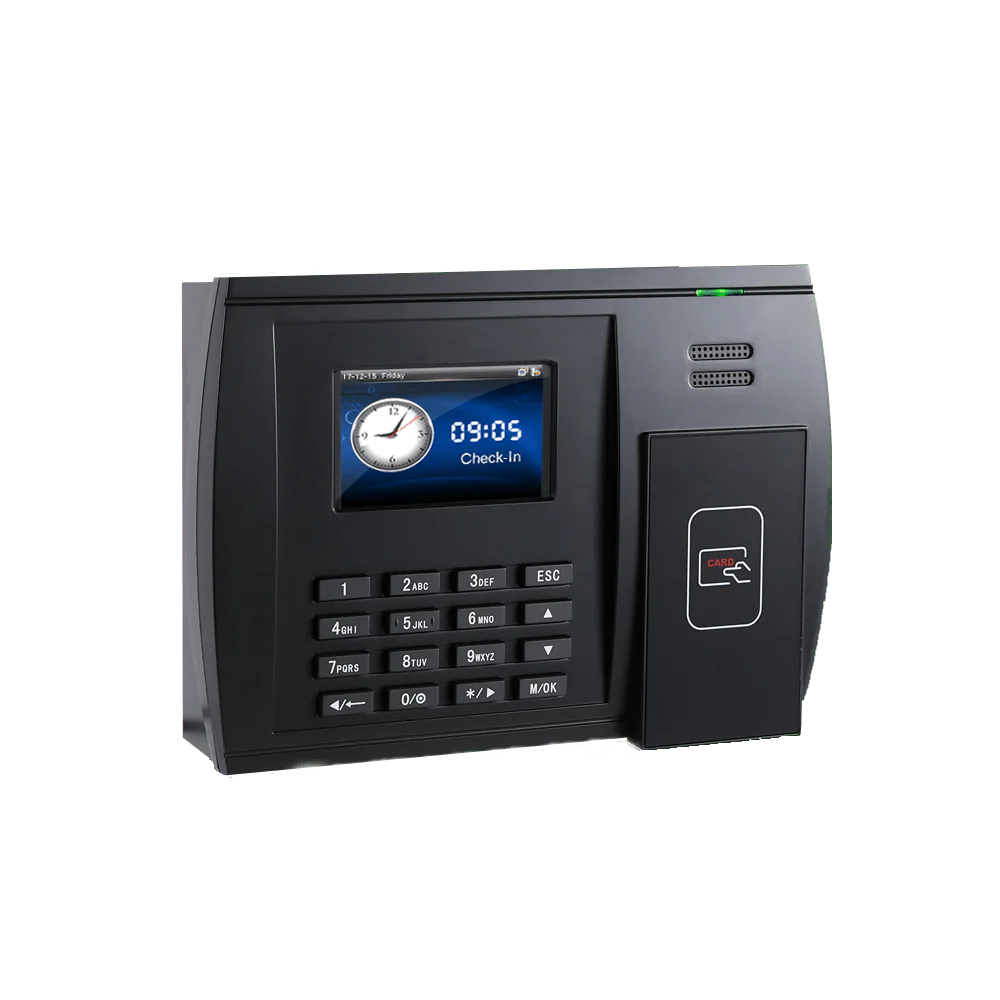
Swipe card clocking records hours when staff tap or swipe a card or fob on a reader. Each card is linked to an employee, so the terminal knows who clocked and when, and sends it to your time and attendance records without anybody writing anything down.

It is quick, robust and needs no phone and no PIN to remember, which suits factories, warehouses and sites where the simplest thing that works is the right answer. The trade-off is that a card can be handed to somebody else. If that matters on your site, biometric clocking is the answer, and plenty of businesses run both.

Flash and go RFID clocking

Nothing touches anything. The card or fob is waved in front of the reader rather than pushed into a slot, so neither wears out with use and dust, grease and residue on the shop floor do not matter. On a busy site that is the difference between a terminal that lasts and one somebody is complaining about by the second winter.

The readers are IP-enabled, so clockings reach your time and attendance records as they happen rather than being collected later, and a wave of the card is quick enough that a queue at seven in the morning keeps moving.

Suited to workshops, factory floors and anywhere the terminal has to put up with the conditions rather than being looked after.

Key benefits

Works with cards you may already have

The proximity reader takes RFID EM cards and fobs, with Mifare or HID as options. If you already issue cards for something else, tell us which and we will check before you reprint anything.

Fast enough for a shift change

A wave of the card rather than a slot to line up with, so forty people arriving together keep moving through the door.

Nothing touched

Contactless, so there is no shared surface at the door and nothing that wears out from being handled all day.

Keeps working when the network does not

The terminal holds up to 200,000 records locally, so an internet outage means clockings carry on and sync later rather than a morning of paper.

Where swipe card clocking works best

A card or fob is the practical answer wherever people clock at a fixed point on their way in.

Factories and workshops

A robust terminal at the entrance, dealing with a whole shift arriving inside ten minutes and putting up with the conditions in between.

Warehouses and logistics

One card that clocks people in and opens the doors they are allowed through, which saves issuing two of everything.

Sites where phones stay in lockers

Plenty of production floors do not allow personal phones, which rules out app clocking entirely. A card is the only thing left that works.

Anywhere with visitors and contractors

Nobody enrols a visitor’s fingerprint for a two-hour site meeting. A temporary card handles it, which is why most sites need cards whatever else they run.

Offices and mixed teams

Cards on the door for people who come in, the app for people who do not, and both landing on the same timesheet.

Technical specification

If you are comparing terminals, this is the part your IT people will want.

Reader
RFID EM, with Mifare or HID as options
Onboard storage
Up to 200,000 log records held on the unit, so clocking continues through a network outage
Confirmation
Audible and visual indicator, so staff know the clocking registered without waiting
Communication
Real time with PUSH technology, so clockings arrive as they happen rather than on a poll
Network
IP enabled ethernet, 10/100Mb, with WiFi as an option
Power
Mains, with Power over Ethernet available, which often saves running a separate supply to the door

Why choose Computime?

For over 35 years, since 1989, we have supplied both the clocking terminals and the time and attendance software behind them, which is less common than it sounds.

It matters when something stops working. The terminal, the software and the payroll export come from one company, so a problem at the door is not a conversation between a manufacturer, a reseller and an installer with you in the middle.

Built and supported by our own team in Leeds. When you call, you speak to someone here.

800+

UK businesses trust Computime systems

35+

years of UK workforce experience since 1989

4.5

average from 41 Google reviews

£395

terminals from, excl. VAT

Swipe card clocking FAQs

What businesses ask before putting card readers in. If yours is not here, call the Leeds team on 0113 350 9043.

What stops one person clocking in for another?
Nothing, if somebody is determined. A card can be handed over, and that is the honest position rather than a small print caveat. What you get is an accurate record of when each card was used, which removes the arguments about start times and is enough for most businesses. If you need certainty that the person is actually there, that is biometric clocking, and we would rather point you at it than sell you the wrong thing.
Can we use the cards we already issue?
Often, yes. The reader takes RFID EM as standard with Mifare and HID as options, and plenty of businesses already issue access or ID cards that will work. Tell us what you have, ideally with the make and model printed on the back, and we will check before you commit to reprinting anything.
What happens when someone loses their card?
You cancel it in the software and issue another, and the old one stops working immediately. That is the practical advantage over keys, where a loss means changing a lock. The practical cost is that somebody has to keep spare cards and remember to do it, which is the small ongoing job biometrics removes.
Do we need to worry about UK GDPR with cards?
Far less than with biometrics. A clocking record is personal data and should be handled properly, but a card number is not special category data, so there is no biometric consent to obtain and no impact assessment specific to that. For a business that wants accurate hours without taking on the biometric obligations, this is the reason to choose cards.
Will it keep working if the internet goes down?
Yes. The terminal holds up to 200,000 records locally and carries on accepting clockings, syncing when the connection returns. Nobody is standing at the door with a clipboard, and nothing is lost.
Can the same card open doors as well as clock in?
Yes, and it saves issuing two of everything. The same card works with our access control systems, so the entry and the clocking are one event, and cancelling a leaver’s card removes both at once rather than in two places.
How many terminals will we need?
It depends on entrances and on how many people arrive at once rather than on headcount. A hundred people trickling in over an hour is a different problem from a hundred arriving for a seven o’clock start. Tell us what your mornings look like and we will say what you actually need.
What does a swipe card clocking machine cost?
Terminals start at £395 excl. VAT as a one-off, plus cards or fobs, with software separate at £2 per employee per month excl. VAT for Syncro Connect. See the full terminal range.

Start A Conversation

Left Menu Icon